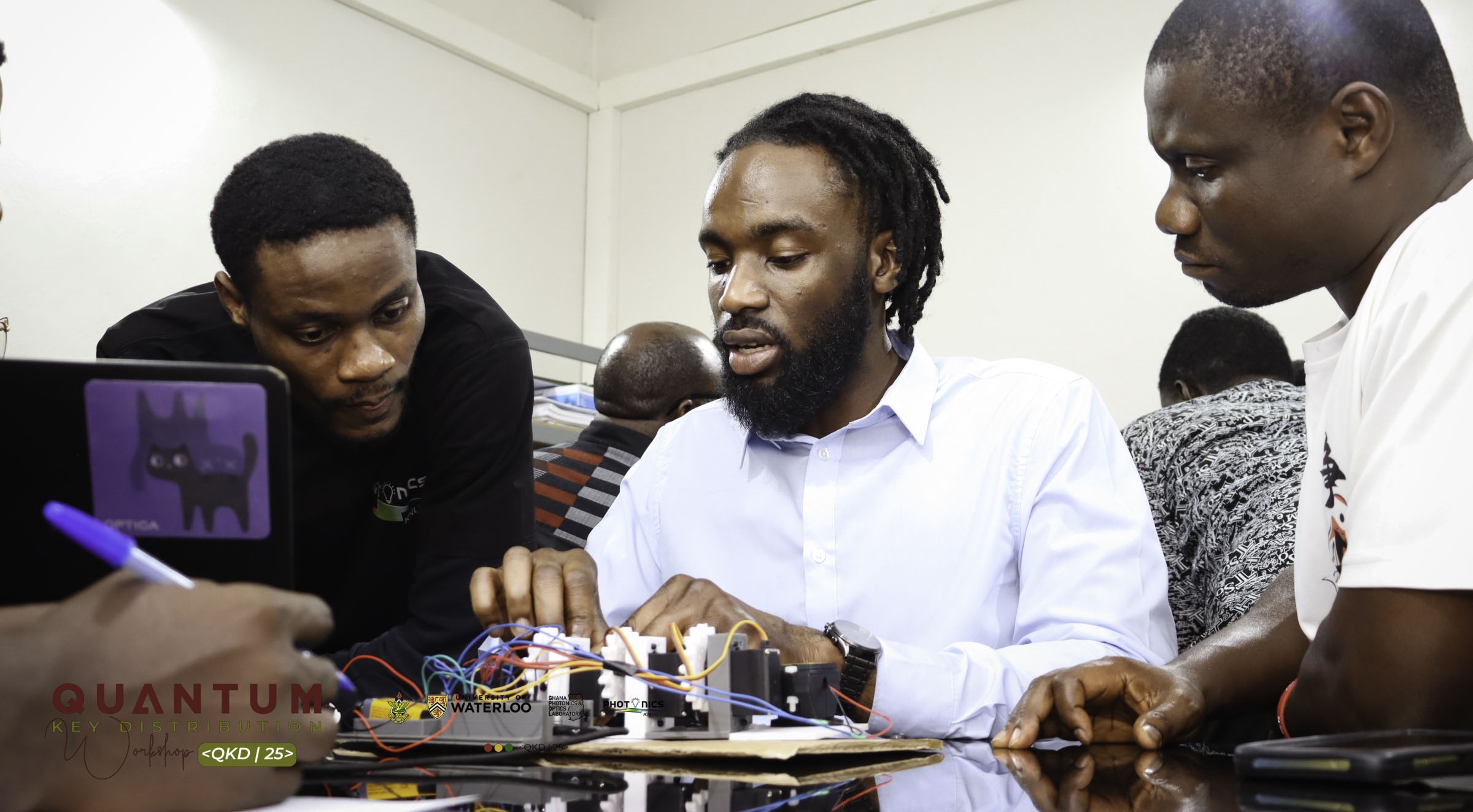
The Ghana Photonics and Optics Laboratory at the Department of Physics, Kwame Nkrumah University of Science and Technology, has held a hands-on workshop on Quantum Key Distribution on Monday, December 15, 2025, to help students and researchers understand how quantum technology can be used to protect digital messages from hacking. The workshop formed part of ongoing efforts by GPOL to expose the KNUST academic community to emerging quantum technologies with direct relevance to secure communication systems that use the laws of quantum physics to securely encrypt information such as emails, banking data and private messages. It also served as part of activities marking the International Year of Quantum Science and Technology, declared in 2025 to raise public awareness of the growing importance of quantum science and its applications.
The session was facilitated by Mr. Silas Ifeanyi, a skilled engineer and researcher affiliated with the Pearl Sullivan Engineering IDEAs Clinic at the University of Waterloo, Canada. His visit to GPOL followed ongoing collaborative engagements between KNUST and international partners in photonics and optics research. The workshop brought together undergraduate students, postgraduate researchers, and laboratory personnel with interests spanning photonics, quantum physics, and applied cybersecurity.
During the lecture session, Mr. Ifeanyi introduced participants to the fundamental principles of Quantum Key Distribution and its relevance in protecting information transmitted using light.
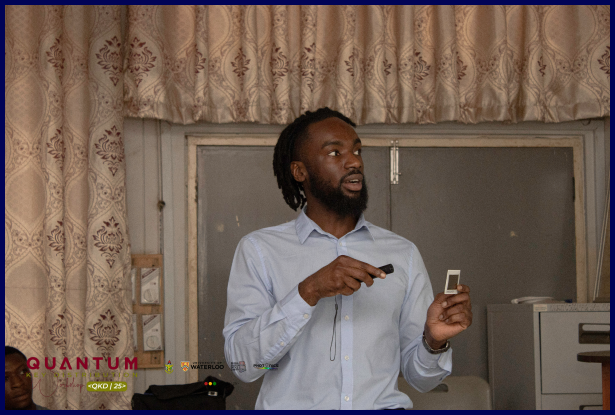
“The system is used to transmit a key, with each light that passes through encoding photons, which means associating a value,” he explained.
He said quantum key distribution enables secure communication by using the principles of quantum mechanics to encrypt and decrypt information, making it more advanced than conventional methods. “Quantum key distribution uses single-photon signals to establish a secure secret key. This makes it possible to detect if there is an eavesdropper tapping into your message,” he said.
Mr. Ifeanyi explained that the QKD system used during the workshop was developed through a collaboration between the IDEAs Clinic and the Institute for Quantum Computing, and was designed specifically for hands-on learning. “It was designed to allow students to practically engage with quantum key distribution as a method of cryptography that utilises quantum technology,” he noted. He described quantum key distribution as essential for the future of secure communication.
“QKD is very important if you care about secure communication in any form. It ensures that information being sent from one party to another remains protected,” he said. Mr. Ifeanyi also warned that many existing security systems are becoming increasingly vulnerable as computing power advances.
“Our current methods of cryptography are vulnerable, and with the advent of quantum computers, we will need a more secure way to send messages whether it’s banking information or simple text messages,” he said.
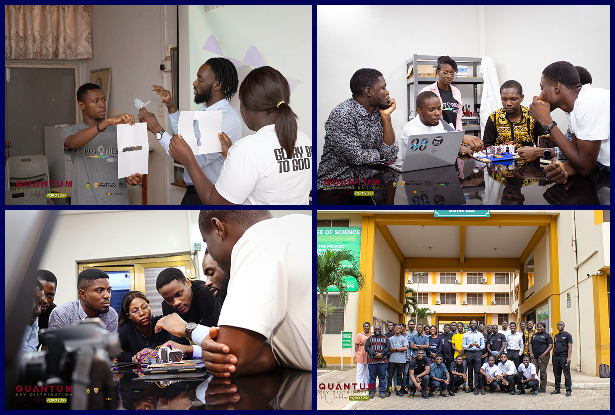
Following the theoretical session, participants engaged in an extended hands on experimental activity. Mr. Ifeanyi introduced 3D printed components and optical equipment which were assembled collaboratively during the session. Using a laser source, participants transmitted light from one point to another while encoding information through the alignment of polarizers at different orientations. This practical exercise allowed participants to directly observe how photons can carry information and how careful alignment is required to encode and decode transmitted data accurately.
The event reinforced the importance of interdisciplinary collaboration between physics, engineering, and cybersecurity, and highlighted the growing relevance of quantum technologies in addressing modern data protection challenges. By hosting training sessions that combine theory with practical experimentation, the Ghana Photonics and Optics Laboratory continues to position itself as a hub for applied photonics and quantum science education within the College of Science and Ghana at large.